West Bengal Reopens Infrastructure Projects to Central Agencies: CPWD, NBCC, RITES & Engineers India Return Under a New Execution Framework — What Changes in 2026?

GFS Realtors
We provide deep market insights and strategic advice for real estate buyers, sellers, and investors.
Expert at providing deep market insights and strategic advice for real estate
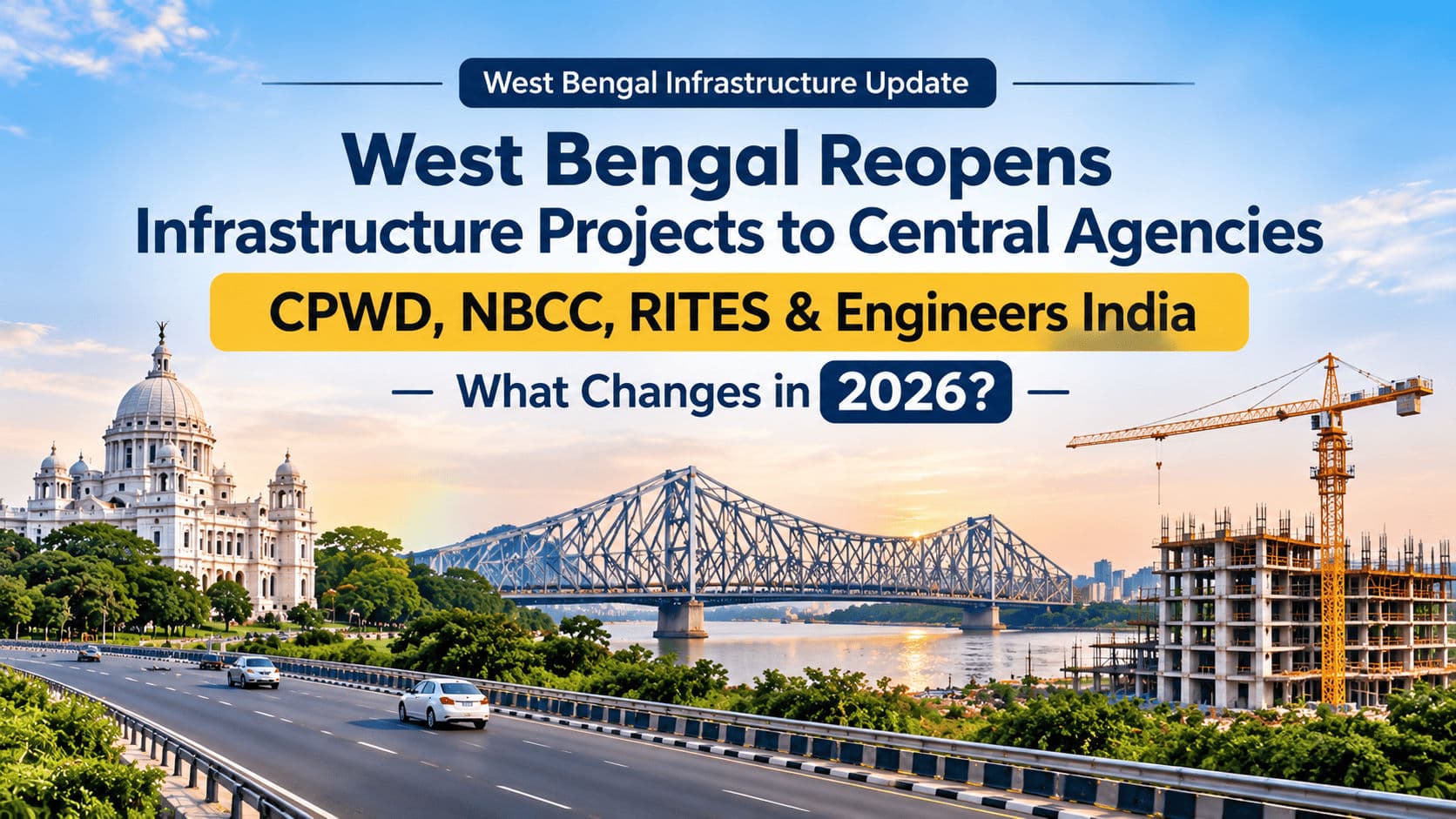
West Bengal Reopens Infrastructure Projects to Central Agencies: CPWD, NBCC, RITES & Engineers India Return Under a New Execution Framework — What Changes in 2026?
A new chapter in Bengal's infrastructure development: exploring the return of central project agencies, revised execution mechanisms, transparent tendering and their potential to shape the state's development landscape.
Direct answer: On 17 November 2026, West Bengal's Finance Department quietly made a change that most citizens will never notice — but that touches the very machinery behind every state road, bridge and public building. It re-listed four central agencies — CPWD, NBCC, RITES and Engineers India Ltd (EIL) — to Annexure-D, allowing them to execute state government works again after they had been removed following an earlier policy shift. The return comes with a clear execution framework: tenders must go through e-tendering portals or GeM, and projects must follow Central Vigilance Commission (CVC) guidelines. This blog looks at who these agencies are, what the re-listing actually means, the new rules of the game, and what could change for Bengal's — and North Bengal's — development in 2026.
Quick Facts — What Was Decided
Item | Detail |
|---|---|
Decision | Re-listing of four central agencies to execute state works |
Date | 17 November 2026 (effective immediately) |
Agencies | CPWD, NBCC, RITES, Engineers India (EIL) |
Legal basis | Added to Annexure-D under Rule 47D, West Bengal Financial Rules |
First listed | 25 June 2012 (later removed after a policy shift) |
Trigger | PWD notification (7 July 2026) adopting a common Schedule of Rates for roads/bridges |
Tendering | Via state/central e-tender portals or GeM (Government e-Marketplace) |
Oversight | Central Vigilance Commission (CVC) guidelines to be followed |
Flexibility | State may add other central organisations later |
Why this is easy to overlook — and shouldn't be: this isn't a flashy new project announcement. It's an execution-layer reform — a change to how and through whom projects get built. And the execution layer is exactly where infrastructure quality, speed and transparency are won or lost.
First, Who Actually Builds a State's Infrastructure?
Most people picture a road or a government building and never wonder who engineered and built it. Behind the scenes sits a layer of specialised project agencies — and the four returning to Bengal are among India's most established. Understanding what each does is the key to this whole story:
Agency | What It Does |
|---|---|
CPWD (Central Public Works Department) | India's principal government construction agency — builds and maintains public buildings, offices, roads and complexes |
NBCC (National Buildings Construction Corporation) | A Navratna PSU specialising in real-estate development, project management and large redevelopment/urban projects |
RITES Ltd | A transport infrastructure consultancy & engineering PSU — expertise in railways, highways, bridges and project management |
Engineers India Ltd (EIL) | An engineering consultancy PSU — large, complex engineering, project management and design |
In short, these are heavyweight, technically deep agencies with decades of experience delivering large, complex public projects across India. When they're available to a state, the state gains access to that execution capacity and expertise.
What Is "Annexure-D" and Why Does It Matter?
Here's the mechanism in plain English. Under the West Bengal Financial Rules (Rule 47D), the state maintains a list — Annexure-D — of approved agencies and PSUs that are permitted to execute government works. If an agency is on that list, state departments can engage it for projects; if it's off the list, they can't.
These four central agencies were first added in 2012, later removed following a policy shift, and have now been restored. So the 17 November decision is essentially the state saying: these four agencies are, once again, allowed to build our projects. It reopens a channel of execution capacity that had been closed.
Why They Left — and Why They're Back
To keep this neutral and factual: central agencies were removed from the Annexure-D list at an earlier point "following a policy shift," and the arrangement for engaging central PSUs on state projects was discontinued. The reasons were part of the broader relationship between the state and the Centre at the time.
The trigger for their return is documented: a PWD notification dated 7 July 2026 adopted the PWD (National Highways) Schedule of Rates as a single, common rate schedule for road and bridge construction. A common rate schedule removes a key friction point — it lets state and central agencies work off the same costing framework — and that, officials indicate, paved the way for the re-listing. The move also fits a broader period of closer state–Centre cooperation on infrastructure funding. (We keep this strictly factual; it's a governance development, not a political endorsement.)
The New Execution Framework: Built Around Transparency
This is the part that matters most for citizens — the rules under which these agencies must now operate:
Mandatory e-tendering — all tenders must be floated through state or central government e-tendering portals, or GeM (the Government e-Marketplace). This pushes procurement onto transparent, auditable digital platforms.
CVC compliance — projects must follow Central Vigilance Commission guidelines, adding an anti-corruption and accountability layer.
Common Schedule of Rates — a single rate schedule for roads and bridges standardises costing and reduces ambiguity.
Flexibility to expand — the state can add other central organisations and corporations to the list over time.
Taken together, these are the ingredients of more transparent, standardised, accountable project execution — which is the real promise of the reform.
What Could Change in 2026 — and Beyond
If the framework works as intended, here's what it could mean:
Dimension | Potential Change |
|---|---|
Execution capacity | Access to heavyweight agencies for large, complex projects |
Technical expertise | Specialised engineering (RITES for transport, NBCC for redevelopment, EIL for complex works) |
Transparency | e-tendering + GeM + CVC oversight |
Standardisation | A common Schedule of Rates for roads and bridges |
Choice | More options for departments, with room to add more agencies |
Delivery | Potentially faster, better-managed project completion |
The underlying idea is simple: more capable builders + more transparent rules = better-delivered infrastructure. That's the goal, at least — delivery is where it will be proven.
The Potential to Shape Bengal's (and North Bengal's) Development
Why should someone in Siliguri care about a Kolkata-issued finance memorandum? Because execution capacity is region-blind — the same agencies that build in Kolkata can build across the state, including North Bengal.
North Bengal is in the middle of a major infrastructure phase — the Bagdogra terminal expansion, the NH-10 Teesta bridge, NH-327 four-laning, railway overbridges and more, as we track in our North Bengal Infrastructure Tracker and Siliguri's Infrastructure Revolution. A deeper bench of capable, accountable project agencies could help deliver such projects more efficiently — and well-executed infrastructure is, ultimately, what makes a region more liveable and investable (Why Siliguri Is North Bengal's #1 Real Estate Investment Destination). This is an enabling, behind-the-scenes change — not a project in itself.
Honest Caveats
Re-listing ≠ immediate projects. Being on Annexure-D makes agencies eligible; actual projects, tenders and awards follow separately.
Delivery is the real test. Frameworks look good on paper; outcomes depend on execution, funding and coordination.
No project list yet. The decision doesn't specify which projects these agencies will take up, or their values.
It's one piece of the puzzle. Better execution machinery helps, but it works alongside funding, land and planning.
🔑 Key Takeaways
🏗️ West Bengal re-listed CPWD, NBCC, RITES & Engineers India (17 Nov 2026) to execute state works again.
📋 It's an Annexure-D change under Rule 47D of the WB Financial Rules — reopening a closed execution channel.
🔑 These are heavyweight agencies — deep technical expertise in buildings, transport, redevelopment and complex engineering.
🔍 Transparency is built in — mandatory e-tendering/GeM and CVC guidelines.
📐 A common Schedule of Rates for roads/bridges (July 2026) triggered the move.
🧭 Region-blind benefit — capacity that can serve North Bengal's infrastructure phase too.
⚠️ Eligibility ≠ delivery — actual projects, tenders and outcomes still have to follow.
👤 About the Author
Written by the Siliguri Properties Team — a hyperlocal resource for Siliguri & North Bengal, tracking the policies, governance and infrastructure developments shaping the region's future.
📚 Related Reads (Explore More on Bengal's Development)
Siliguri's Infrastructure Revolution: What It Means for the Region
Bagdogra Airport Expansion: Which Siliguri Localities Benefit Most
Why Siliguri Is North Bengal's #1 Real Estate Investment Destination
The Complete 2026 Roadmap to Investing in Siliguri Property (GFS)
📌 Stay Updated on Bengal's Infrastructure & Governance
Behind every road and building is an execution system — and changes to it shape how fast and how well a state develops. For clear, balanced updates on Bengal's infrastructure and sound property guidance:
👉 Follow SiliguriProperties.com and GFS Realtors.
📞 Talk to GFS Realtors — Sanat Trade Center, 1st Floor, Sevoke Road, Siliguri-01. Call +91 99320 66666. With 20+ years in North Bengal's property market, we help you understand how development shapes locations — and verify every property end-to-end before you commit.
This article is general information based on reported details of West Bengal's Finance Department decision (17 November 2026) to re-list CPWD, NBCC, RITES and Engineers India Ltd to Annexure-D, for informational purposes only — not investment, legal, financial or political commentary. Details, framework conditions and project implications are as reported and subject to change. Always verify official notifications with government sources.