Bagdogra Airport Expansion 2026–2027: How the ₹1,549-Crore New Terminal, Rising Passenger Capacity & Improved Connectivity Could Transform Siliguri's Property Market

GFS Realtors
We provide deep market insights and strategic advice for real estate buyers, sellers, and investors.
Expert at providing deep market insights and strategic advice for real estate

Bagdogra Airport Expansion 2026–2027: How the ₹1,549-Crore New Terminal Could Transform Siliguri's Property Market
As Bagdogra Airport prepares for a major transformation, discover how expanding aviation infrastructure, growing passenger movement and improved road connectivity could influence property demand, prices and investment across Siliguri's emerging growth corridors.
Direct answer: Bagdogra isn't getting an upgrade — it's getting a rebuild. The Union Cabinet sanctioned a ₹1,549-crore new civil enclave (approved alongside Bihta, under a combined ₹2,962 crore), featuring a 70,390 sq m terminal built for 1 crore (10 million) passengers a year and 3,000 peak-hour passengers — nearly a tenfold jump from today, targeted for completion around 2027. Here's the insight that makes this a property story, not just an aviation one: airports don't only move people — they reshape the land around them. Economists call it the airport effect (or "aerotropolis"). This deep-dive applies that lens to Siliguri — a phased, corridor-by-corridor look at how the expansion could influence property demand, prices and investment, with honest caveats on timing and zoning.
Quick Facts — The Bagdogra Expansion
Item | Detail |
|---|---|
Sanctioned cost | ₹1,549 crore (Union Cabinet / CCEA, Aug 2024) |
Part of | ₹2,962 crore combined approval (Bagdogra + Bihta) |
Terminal size | 70,390 sq m new civil enclave |
Annual capacity | 1 crore (10 million) passengers |
Peak-hour capacity | 3,000 passengers |
Apron / parking | 10 aircraft parking bays (A-321 type), 2 link taxiways, multi-level car parking |
Features (reported) | 6 aerobridges, 56 check-in counters, 1,000-car MLCP, 5-star GRIHA green terminal |
Completion target | ~2027 (widely reported as March 2027) |
Status | Under construction |
On the numbers: ₹1,549 crore is the Cabinet-sanctioned figure; some later reports cite ~₹1,560 crore (close variants of the same project). The terminal size appears as 70,390 sq m in the sanction, with later reporting citing a larger footprint — confirm the final figure with official sources. Either way, the scale is transformational.
The Big Idea: What Is "The Airport Effect"?
This is the concept that reframes the whole story. A major airport is one of the most powerful pieces of infrastructure a region can have, because it generates a self-reinforcing economic zone around itself — a phenomenon urban economists call the aerotropolis or simply the airport effect.
Here's how it works:
A bigger airport → more flights & passengers → more hotels, offices, logistics, retail & services locate near it → jobs and footfall rise → demand for housing, commercial and land in the catchment grows → the periphery urbanises and values firm up.
India has clear examples: Hyderabad's RGIA and Bengaluru's KIA turned their once-remote peripheries into booming real-estate corridors over the years following their expansion. The pattern is consistent — though, crucially, it unfolds over years, not months, and unevenly. That balanced lens is exactly how to read Bagdogra's impact on Siliguri.
Why Bagdogra's Expansion Is Different From a Routine Upgrade
Three things make this a genuine inflection point:
Scale. Going from roughly today's capacity to 1 crore passengers a year isn't incremental — it changes Bagdogra's category, from a constrained regional airport to a true gateway.
Gateway position. Bagdogra serves not just Siliguri but Sikkim, Bhutan, Nepal, Darjeeling, Kalimpong and the Dooars — a vast catchment funnelling through one airport.
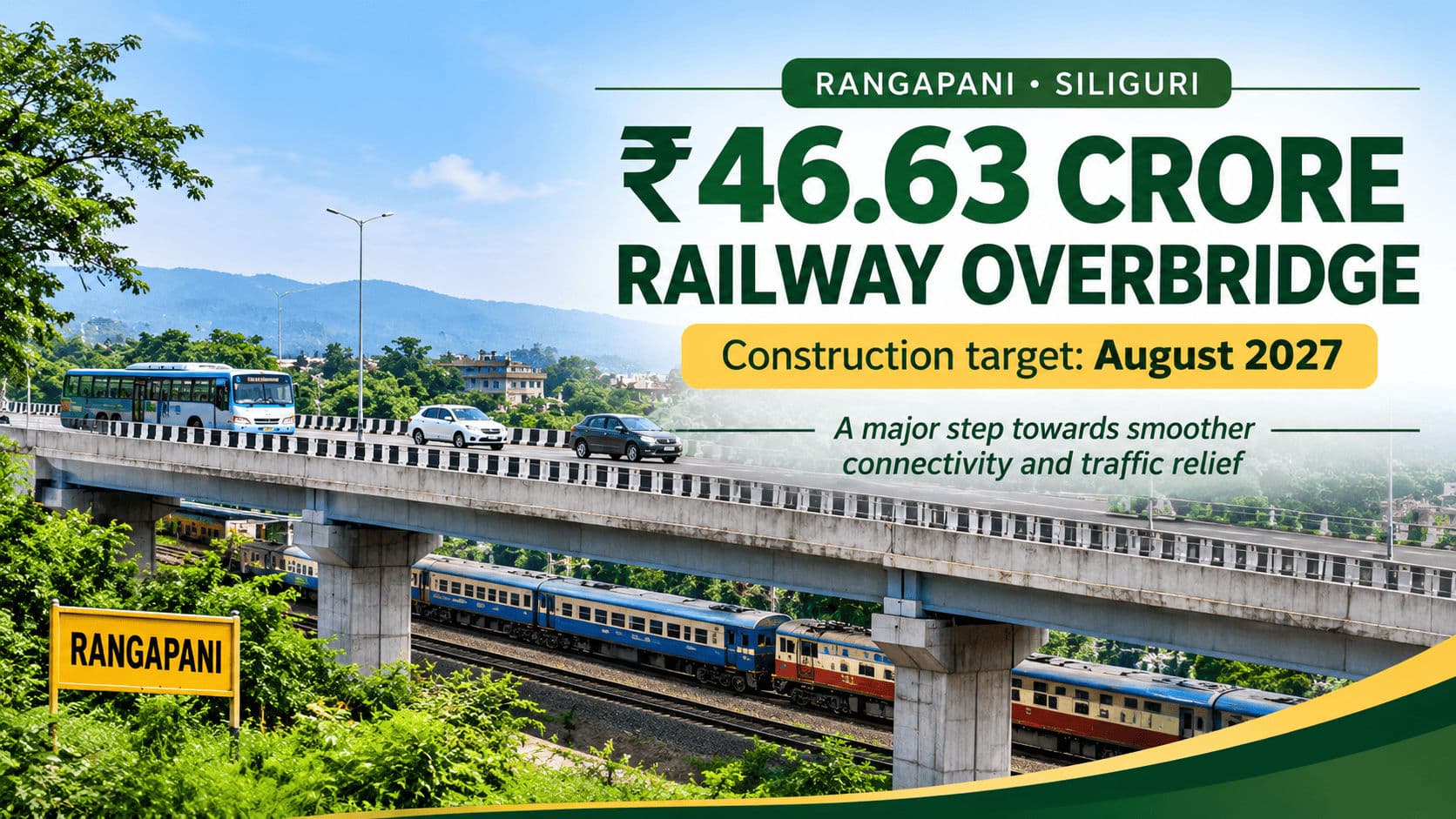
Convergence. It's expandingalongside NH-327 four-laning, the NH-10 Teesta bridge, the Rangapani railway overbridge and a hospitality boom — so the airport effect compounds with other drivers, as we track in the
North Bengal Infrastructure Tracker and Siliguri's Infrastructure Revolution.
A Phased View: How the Impact Could Unfold (2026 → 2027 → Beyond)
Rather than a vague "prices will rise," here's a realistic timeline of how the airport effect typically plays out — framed as potential, not promise:
Phase | Period | What Typically Happens |
|---|---|---|
Construction phase | 2026–2027 | Anticipation builds; early investor interest in the airport belt; land enquiries rise ahead of completion |
Operational phase | ~2027–2029 | Terminal opens; passenger traffic scales; hospitality, logistics & commercial demand activates; rentals firm up |
Maturity phase | 2029 onward | The catchment urbanises; residential, retail & office demand deepens; the "airport corridor" consolidates |
The key takeaway: the smartest window is usually the construction phase — before the capacity is live — because that's when the belt is still priced on today's reality, not tomorrow's. But it must be matched with patience and due diligence.
The Corridors to Watch — Where the Airport Effect Lands
The airport effect is intensely location-specific. Here's how it could play out across Siliguri's airport-facing belts (type of demand, not guaranteed appreciation):
Corridor / Area | Likely Demand Type | Why |
|---|---|---|
Rangapani / airport belt | Land, plots, hospitality, logistics | Closest to the terminal; being de-bottlenecked by the new railway overbridge. Rangapani Guide |
Matigara | Residential, commercial, hospitality, retail | Established hub between airport & city. Matigara Guide |
NH-327 corridor | Logistics, warehousing, commercial | Four-laning + airport = freight & trade axis |
Fulbari | Warehousing, air-cargo-linked land | Supply-chain catchment. Fulbari Guide |
Uttorayon / Sevoke side | Premium residential, hospitality | Lifestyle demand from a better-connected city |
For a data-led ranking across Siliguri, see Siliguri's Best Localities to Invest In and the GFS Top 10 Emerging Real Estate Corridors in Siliguri. Our earlier deep-dive, Bagdogra Airport Expansion: Which Siliguri Localities Benefit Most, maps the catchment in detail. Live options on these belts include Tulsi Vatika, Rangapani, Utsodhaara Residencia, Kawakhari and Darpan 88, Sevoke Road.
How Different Property Segments Could Respond
Segment | Potential Effect |
|---|---|
Land & plots | Earliest, sharpest interest in the airport belt |
Hospitality | Hotels, serviced apartments & homestays for rising air traffic |
Logistics & warehousing | Air cargo + NH-327 drive demand near Fulbari/Rangapani |
Commercial & retail | Travel services, F&B, retail follow footfall |
Residential & rentals | Staff housing and professional rentals near the belt |
This connects to the hospitality wave in North Bengal's Hospitality Boom and the income angle in Rental Yield in Siliguri.
The Overlooked Caveat: Airport Zoning & Height Rules
Here's something most "airport will boom property" articles never mention — and it matters. Land very close to an airport comes with building-height restrictions and zoning rules (under aviation safety norms) that can limit what you build. Proximity is valuable for land and commercial use, but for high-rise residential it can be a constraint. So "near the airport" isn't automatically ideal for every use — the right location depends on your intended use and the applicable rules. Always verify zoning and height norms for a specific parcel before buying — see How to Verify a Property Is 100% Legally Safe Before You Buy in Siliguri.
Honest Caveats
The airport effect is gradual. It unfolds over years, strengthening as the terminal nears and after it opens — not overnight.
Delivery risk. Completion is targeted for ~2027; large projects can slip.
Uneven impact. Benefits concentrate in specific corridors, not everywhere equally.
Zoning & height limits. Airport-proximity rules shape what's buildable where.
Fundamentals still rule. Title, access and price paid decide outcomes — not the airport alone.
What Buyers & Investors Should Do
Focus on the real catchment — airport belt, NH-327, Matigara, Fulbari — not just "anywhere in Siliguri."
Match the parcel to a use that suits its zoning (land/logistics/commercial vs residential).
Verify everything — title, mutation, land-use, and especially airport-zone/height rules (Documents Required to Buy a Flat or Land in Siliguri, WBRERA Explained).
Think in phases — enter early on fundamentals, hold with patience through the construction-to-operational transition.
Avoid speculation — don't overpay on hype; buy clean-title property at sensible prices.
For strategy, the GFS Complete 2026 Roadmap to Investing in Siliguri Property and North Bengal Real Estate 2026 Complete Guide are useful companions.
🔑 Key Takeaways
✈️ Bagdogra's ₹1,549-crore new terminal is built for 1 crore passengers a year (~10× today), targeted for ~2027.
🌐 "The airport effect" — airports reshape surrounding land; proven in Hyderabad, Bengaluru and beyond.
📈 It unfolds in phases — anticipation (2026–27) → activation (2027+) → maturity — with the construction phase often the smartest entry.
📍 Corridor-specific — Rangapani/airport belt, Matigara, NH-327 and Fulbari are the primary catchment.
🏗️ Segments — land, hospitality, logistics, commercial and rentals respond differently and at different times.
⚠️ Mind the zoning — airport-height/zoning rules shape what's buildable; verify before buying.
✅ Buy on fundamentals, with patience — the effect is real but gradual, and location/title still decide outcomes.
👤 About the Author
Written by the Siliguri Properties Team — a hyperlocal resource for Siliguri & North Bengal, turning infrastructure developments into clear, grounded insights for buyers and investors.
📚 Related Reads (Explore the Airport Corridor)
Bagdogra Airport Expansion: Which Siliguri Localities Benefit Most
North Bengal's Hospitality Boom: Every Major Hotel Brand Coming
Why Investing in Plots in Siliguri is One of the Smartest Moves
Siliguri's Best Localities to Invest In: A Data-Driven Ranking
The Complete 2026 Roadmap to Investing in Siliguri Property (GFS)
🏡 Position Early on the Airport Corridor — With Verified Title.
A 1-crore-passenger gateway changes everything around it — but the airport effect rewards patient buyers who enter early, in the right corridor, with verified title and the right zoning. That's exactly where GFS Realtors adds value.
👉 Explore land, plots, flats & commercial spaces across Siliguri's airport corridors on SiliguriProperties.com and GFS Realtors.
📞 Talk to GFS Realtors — Sanat Trade Center, 1st Floor, Sevoke Road, Siliguri-01. Call +91 99320 66666. With 20+ years in North Bengal's market, we help you identify the right airport-corridor opportunity — and verify title, land-use and zoning end-to-end before you commit.
This article is general market commentary based on reported details of the Bagdogra Airport expansion (₹1,549 crore Cabinet sanction, 2024; ~70,390 sq m terminal; 1 crore annual capacity; completion targeted ~2027), for informational purposes only — not investment, financial or legal advice. Project cost, size and timelines are as reported and subject to change. Property outcomes depend on location, zoning, title, price and delivery, and are not guaranteed. Always verify a property's legal status, land-use and airport-zone/height rules with a qualified professional before investing.