
₹2,077 Crore Siliguri Corridor Highway Expansion: The 2026 Real Estate Growth Map — Which Areas Could See the Biggest Property Price Gains?

GFS Realtors
We provide deep market insights and strategic advice for real estate buyers, sellers, and investors.
Expert at providing deep market insights and strategic advice for real estate
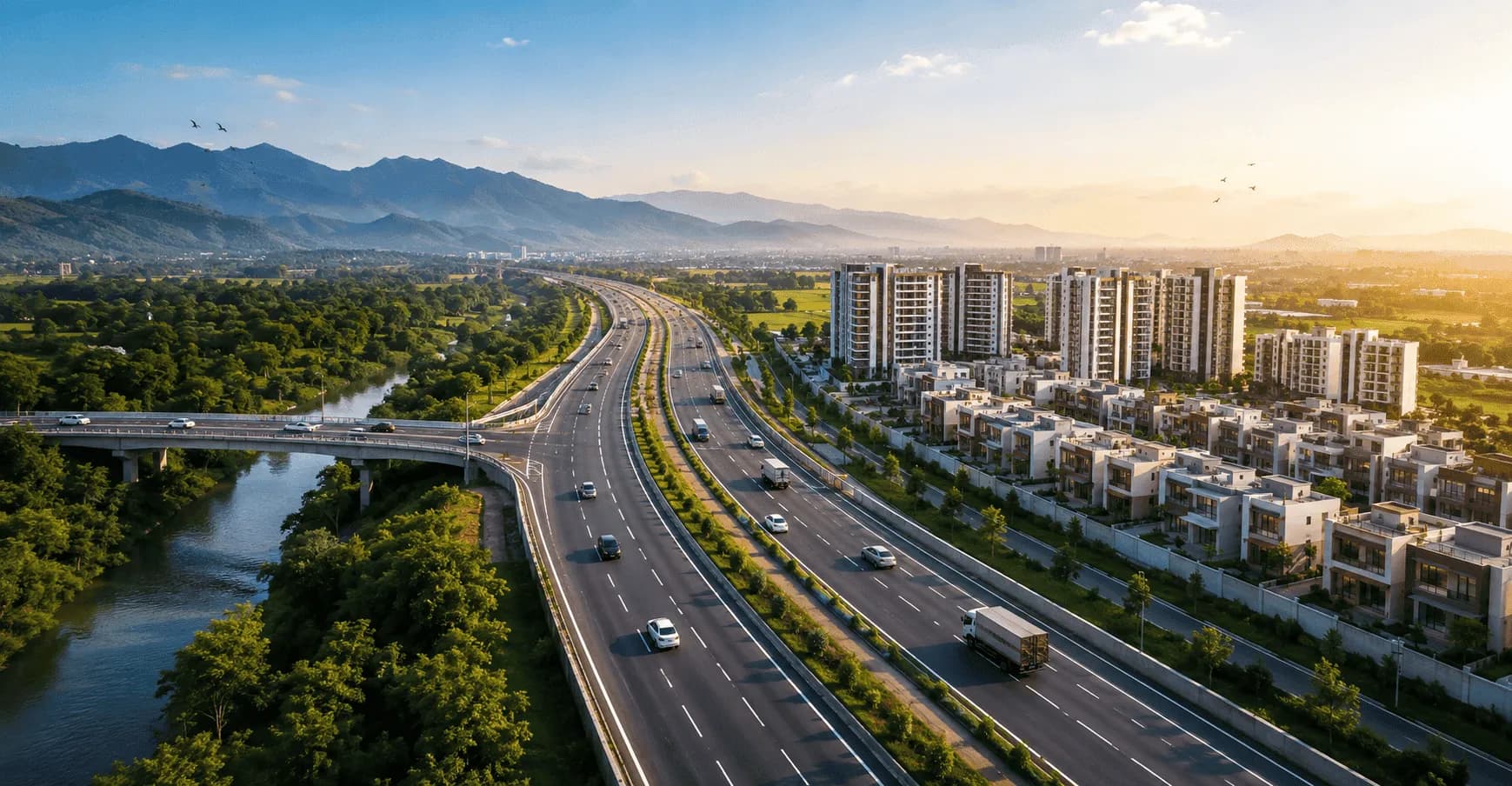
₹2,077 Crore Siliguri Corridor Highway Expansion: The 2026 Real Estate Growth Map — Which Areas Could See the Biggest Property Price Gains?
Executive Summary & The Macro Thesis
The Centre has approved ₹2,077.18 crore to four-lane the 31.02-km Bagdogra–Panitanki–Kharibari–Galgalia section of NH-327 — the highway that stitches Bagdogra in Darjeeling district to Galgalia in Bihar's Kishanganj, threading the Siliguri Corridor. For a road, that's a big number. For a real estate investor, it's something more precise: a repricing trigger on a specific set of parcels.
Here's the thesis, stated plainly. Siliguri is no longer a sleepy transit town on the way to Darjeeling and Sikkim. It is the economic and strategic heart of East India — the "Chicken's Neck," a ~22-km-wide strip that is the only land bridge between mainland India and the eight northeastern states, serving a catchment of 40–50 million people plus the trade gateways to Nepal, Bhutan and Bangladesh. When the Union government pours capital into hardening and widening this corridor, it is simultaneously making the land along it more accessible, more tradeable, and more valuable.
And the key nuance for anyone deploying capital: appreciation will not be uniform. It follows the tarmac. Land within the catchment of a widened highway, a new flyover, or a logistics link re-rates; land two corridors away does not. The investor's job in 2026 is to read the map correctly — which is exactly what this analysis provides. (For the foundational case, see why Siliguri is North Bengal's #1 real estate investment destination and the North Bengal Real Estate 2026 complete guide.)
The equation driving everything below is simple and durable: Connectivity → Accessibility → Demand → Yield.
Deep-Dive: The ₹2,077 Crore Highway Expansion, Unpacked
Let's get specific about what's actually being built, because the route is the investment map.
The project: four-laning of NH-327 from Bagdogra → Panitanki → Kharibari → Galgalia (~31 km), at ₹2,077.18 crore, with three major bridges, one road-over-bridge, five elephant underpasses, and service roads on both sides. That last detail matters more than it looks: service roads create frontage — the developable, commercially valuable edge along a highway.
Why this specific alignment is a big deal for property:
🛂 Panitanki is the Indo-Nepal gateway. This isn't just a commuter road — it's a cross-border trade artery. Widening it supercharges the movement of goods, which is rocket fuel for warehousing, logistics and commercial land along the belt.
✈️ It originates at Bagdogra — the same node getting a 10× airport terminal expansion (Bagdogra airport expansion & the corridor). Highway + airport at the same anchor point is a rare, compounding catalyst.
🔗It plugs into the Gorakhpur–Siliguri Expressway. The 519-km, ~₹38,645-crore greenfield expressway junctions with NH-327 near Kishanganj/Bagdogra — so this ₹2,077 cr stretch becomes a feeder into a national-scale corridor, multiplying its strategic weight.The mega-project cluster it sits inside — and this is what turns a single highway into a citywide re-rating:
🛣️ Seven NH stretches handed to NHAI/NHIDCL in 2026 (incl. NH-31, NH-33, NH-312, and the Sevoke–Coronation Bridge NH-10 route) — resolving a year-long deadlock and unlocking faster idening/modernisation.
🏗️ The NH-10 elevated corridor across northern Siliguri, easing the city's chronic congestion.
🚆 NJP station redevelopment and rail doubling toward Siliguri Junction.
🚧 Eastern Bypass upgrades diverting through-traffic and opening new frontage.
🛒 Anchors already on the ground: City Centre Matigara, Bengal Safari, the Asian Highway AH2 (NH-27)
east-west spine.
Track the full pipeline in our North Bengal infrastructure tracker and Siliguri infrastructure revolution analyses. Now — where does the money land?
The 2026 Real Estate Growth Map: Micro-Market Breakdown
Five corridors will absorb most of this infrastructure dividend. Here's the spatial analysis, corridor by corridor.
1. Bagdogra–Matigara Axis — The Airport-Highway Powerhouse 🛫
The single strongest micro-market, because it sits at the intersection of the two biggest catalysts: the NH-327 expansion originates here, and the 10× Bagdogra airport terminal anchors it.
Key infrastructure trigger: NH-327 four-laning + airport terminal + Gorakhpur–Siliguri Expressway junction + City Centre Matigara arterial access.
Asset class focus: high-density residential, luxury high-rises, commercial retail near the airport, hospitality (serviced apartments).
3–5 yr appreciation target: ~40–60%+ in the strongest pockets (indicative) — the broadest demand base in the city.
Investor profile: HNIs and NRIs seeking blue-chip appreciation + rental; developers for high-density and commercial. Matigara consistently tops our data-driven locality ranking; go deep via the Matigara locality guide.
💡 Pro-Investor Tip: near an airport, serviced apartments and retail often out-yield plain residential — the transient, business and tourist footfall pays a premium. Pair the growth-corridors thesis with a clear asset-class call.
2. Fulbari–NJP Corridor — The Logistics & Trade Goldmine 📦
The highest-conviction land play. This belt is where NH-10 begins toward the Indo-Bangladesh border, where NJP station redevelopment lands, and where Panitanki-driven cross-border trade demands warehousing at scale.
Key infrastructure trigger: NH-327 trade uplift, NJP redevelopment, bypass connectivity, border-trade logistics.
Asset class focus: warehousing, industrial land, logistics parks, and affordable-to-mid residential for the workforce.
3–5 yr appreciation target: ~35–55% on well-located land (indicative); warehousing yields are structurally attractive.
Investor profile: land bankers, logistics/industrial investors, commercial developers. See the Fulbari land & warehouse investment guide and warehouse & industrial property.
💡 Pro-Investor Tip: trade corridors reward industrial land more reliably than glamorous residential. As cross-border and e-commerce logistics scale, Grade-A warehousing near NJP/Fulbari is a multi-year theme, not a spike.
3. Eastern Bypass & Salugara — The Sikkim-Bhutan Growth Artery 🌿
The eastern release valve. As the bypass and the NHAI-handed Sevoke–Coronation Bridge (NH-10) route ease traffic toward Sikkim, Bhutan and the Dooars, the Salugara–bypass belt converts from "on the edge" to "well-connected."
Key infrastructure trigger: Eastern Bypass upgrades, NH-10 Sevoke route, decongestion, new commercial zones.
Asset class focus: mid-income residential, gated communities, plotted developments, roadside commercial.
3–5 yr appreciation target: ~30–50% (indicative); strong value-to-growth ratio.
Investor profile: end-users, mid-segment investors, plotted-land buyers. See the Salugara locality guide
4. Sevoke Road Belt & Northern Outskirts — The Premium Spine 🏙️
Siliguri's prestige corridor — and it gets more central as the NH-10 elevated corridor and the Sevoke route to Sikkim strengthen. This is the luxury-and-retail play.
Key infrastructure trigger: NH-10 elevated corridor, Sevoke–Coronation Bridge upgrade (NHIDCL), premium retail density.
Asset class focus: premium/luxury high-rises, high-street retail, offices.
3–5 yr appreciation target: ~25–40% (indicative) — lower percentage off a higher base, but the deepest premium demand and liquidity.
Investor profile: HNIs/NRIs for trophy residential and retail; end-users wanting the best address. See the
Sevoke Road locality guide, its commercial-retail rise, and premium projects on Sevoke Road.
💡 Pro-Investor Tip: on a premium spine, retail frontage and branded residences hold value best — but confirm the new highway 40m/75m setback rule before valuing any NH-facing plot here.
5. Rangapani–Naxalbari Peripheral Belt — The Land-Banking Frontier 🌱
The highest-risk, highest-multiple frontier. Directly on the NH-327 alignment toward Panitanki/Kharibari, this belt is where today's ₹-per-katha is lowest and the connectivity uplift is proportionally largest.
Key infrastructure trigger: direct NH-327 four-laning, airport proximity, cross-border trade access.
Asset class focus: affordable plotted developments, raw land banking, self-build plots.
3–5 yr appreciation target: ~40–70%+ on well-chosen parcels (indicative) — the widest range, and the widest risk.
Investor profile: patient land bankers, higher-risk-tolerance investors, self-build end-users. See the Rangapani locality guide, Tulsi Vatika plots in Rangapani and plotted developments from ₹15–20L.
💡 Pro-Investor Tip: peripheral land offers the biggest multiples but the longest liquidity timeline and the highest title risk. This is where you buy right or lose — verification is non-negotiable (covered below).
The Comparative Investor Matrix (2026)
A single view to match capital to corridor. (Price ranges and CAGR are indicative, drawn from market observation for 2026; verify current figures — infrastructure timelines and returns are not guaranteed.)
Corridor | Dominant Asset Type | Indicative Price Range | 3-Yr Appreciation Potential | Risk vs Reward |
|---|---|---|---|---|
Bagdogra–Matigara | High-rise residential, retail, hospitality | Higher / core pricing | 🟢 Very High (~40–60%+) | Med (proven demand) |
Fulbari–NJP | Warehousing, industrial land | Mid, land-led | 🟢 High (~35–55%) | Med–High |
Eastern Bypass–Salugara | Mid residential, plots, gated | Mid | 🟢 High (~30–50%) | Med |
Sevoke Road belt | Luxury, high-street retail | Premium / highest | 🟡 Steady (~25–40%) | Low–Med (liquid) |
Rangapani–Naxalbari | Plots, raw land banking | Lowest entry | 🔴 Highest (~40–70%+) | High (long liquidity) |
How to read it: Sevoke Road is the capital-preservation premium play; Bagdogra–Matigara is the blue-chip growth play; Fulbari–NJP is the cash-flow/land play; the Bypass–Salugara belt is the balanced value play; Rangapani–Naxalbari is the aggressive multiple play. Match the corridor to your mandate. (Frameworks: land, flat or commercial and the complete 2026 investing roadmap.)
Strategic Investment Playbook for 2026
When to Enter — Ride the Valuation Curve
Infrastructure repricing runs on a predictable announcement → construction → completion curve, and this ₹2,077 cr approval has just fired the first gun.
🟢Pre/early-construction (now): maximum upside, higher risk. Best for land banking in Rangapani–Naxalbari and Fulbari, where the multiple is largest.
🟡 Under-construction: de-risked, momentum visible — the sweet spot for residential/commercial in Bagdogra–Matigara and the Bypass belt (weigh under-construction vs ready-to-move).
🔵 Post-completion: lowest risk, connectivity already priced in — suits conservative capital and premium Sevoke Road assets.
💡 Pro-Investor Tip: the discipline is to enter early where you can hold, and hold where you enter late. Match your entry point to your liquidity horizon, not to the hype.
What to Buy — Match Asset to Objective
💰 Cash flow / yield: warehousing (Fulbari–NJP), retail (Sevoke/Matigara), rental residential (
📈 Capital appreciation: high-density residential (Matigara), plotted land (Rangapani, Salugara).
🏦 Land banking: peripheral parcels on the NH-327 alignment — lowest entry, longest hold, biggest multiple.
🌍 NRI mandate: ready/near-ready, low-management assets in core corridors — follow the NRI property guide.
Key Risks & Red Flags — Where Deals Go Wrong in West Bengal
This is where a HNI protects capital. The demand story is strong; the legal story is where investors get hurt.
🍃Tea garden & agricultural land legalities. Vast tracts near these corridors carry complicated tenure.
Agricultural or tea-grant land sold as residential without valid conversion is the #1 trap — verify class and conversion first (can you build on this plot? conversion & zoning).
📜 Title & records. Double-deed and benami risks are real in a hot market — run full legal-safety verification
, and use ULPIN & digital land records plus mutation checks.
🛣️Highway setback & zoning. NH-facing land now faces the 40m/75m setback rule; confirm buildable depth before valuing frontage.
🌳Environmental/eco-sensitive zones near forests and rivers can restrict development.
⏳Liquidity timelines. Peripheral land can take years to exit — size your position to your horizon.
📊 Screen everything through the Siliguri property risk map and price your buy well with our negotiation playbook.
💡 Pro-Investor Tip: in West Bengal, the discount you get on un-verified land is usually the risk, priced in. Budget for a lawyer's title opinion on every corridor deal — it's the cheapest insurance you'll buy.
Conclusion: From Transit Town to Real Estate Power Centre
Strip away the strategic language and the investment case is concrete. A ₹2,077 crore highway is being four-laned through the most important 22 kilometres in India, anchored on a Bagdogra node that is also getting a 10× airport, feeding a 519-km expressway, inside a corridor where seven national highways just moved to central agencies for faster execution. That is not one catalyst — it's a stack of them, converging on specific corridors.
The result over the next 3–5 years will be a Siliguri that completes its transformation from a transit town into a genuine real estate power centre for East India. But the gains will be spatial, not uniform — they'll run along the tarmac: Bagdogra–Matigara, Fulbari–NJP, the Eastern Bypass–Salugara belt, the Sevoke premium spine, and the Rangapani–Naxalbari frontier. The investors who win will be those who read the map early, match asset class to corridor, verify title rigorously, and hold with patience.
The map is drawn. The capital is committed. The only question left is where you position before the rest of the market catches up.
🔑 Key Takeaways
🛣️ ₹2,077 cr four-laning of NH-327 (Bagdogra–Panitanki–Kharibari–Galgalia) is a repricing trigger for the western/border corridor.
🧭 Growth is spatial — it follows the highway, not the whole city.
🛫Bagdogra–Matigara = strongest (airport + highway); Fulbari–NJP = best land/logistics; Sevoke = premium;
Rangapani–Naxalbari = highest multiple, highest risk.
⏱️Enter early where you can hold; match entry point to liquidity horizon.
🛡️Legal risk > demand risk — verify tea-garden/agri conversion, title, setback and zoning.
🌆Stacked catalysts re-rate Siliguri into an East India real estate power centre over 3–5 years.
👤 About the Author
Written by the SiliguriProperties Editorial Team — GFS Realtors' hyperlocal property resource for Siliguri & North Bengal, with 20+ years of combined experience mapping infrastructure to investment across the region. ✅ Fact-checked by CA Sanjay Goyal — Chartered Accountant & Founder, GFS Realtors. See why choosing the right realtor matters.
📚 Related Reads (Solve Every Related Query Here)
Bagdogra Airport Expansion 2027 & the Siliguri–Bagdogra Corridor
Top 10 Emerging Real Estate Corridors in Siliguri 2026 (GFS)
The Complete 2026 Roadmap to Investing in Siliguri Property (GFS)
🏡 Position Before the Market Catches Up.
The corridor map is drawn and the ₹2,077 crore is committed. The window to enter before the repricing fully lands is now — in the right corridor, in a verified asset.
👉 Explore shortlisted, verified properties across every Siliguri growth corridor on SiliguriProperties.com
📞 Talk to GFS Realtors — Sanat Trade Center, 1st Floor, Sevoke Road, Siliguri-01. Call +91 99320 66666. Our advisory team maps the corridor to your mandate — appreciation, yield or land banking — sources shortlisted assets, and verifies title, conversion and zoning end-to-end before you deploy capital.
This article is general market analysis for information only — not investment advice. Project details, costs, timelines and appreciation figures are as reported/observed for 2026 and are indicative and subject to change; infrastructure timelines can slip and returns are not guaranteed. Always verify a property's legal status, land classification, approvals and applicable regulations with the relevant authorities and qualified professionals before investing.