Siliguri–Gangtok in 90 Minutes: How Faster Sikkim Connectivity Could Reshape Siliguri's Property Market

GFS Realtors
We provide deep market insights and strategic advice for real estate buyers, sellers, and investors.
Expert at providing deep market insights and strategic advice for real estate
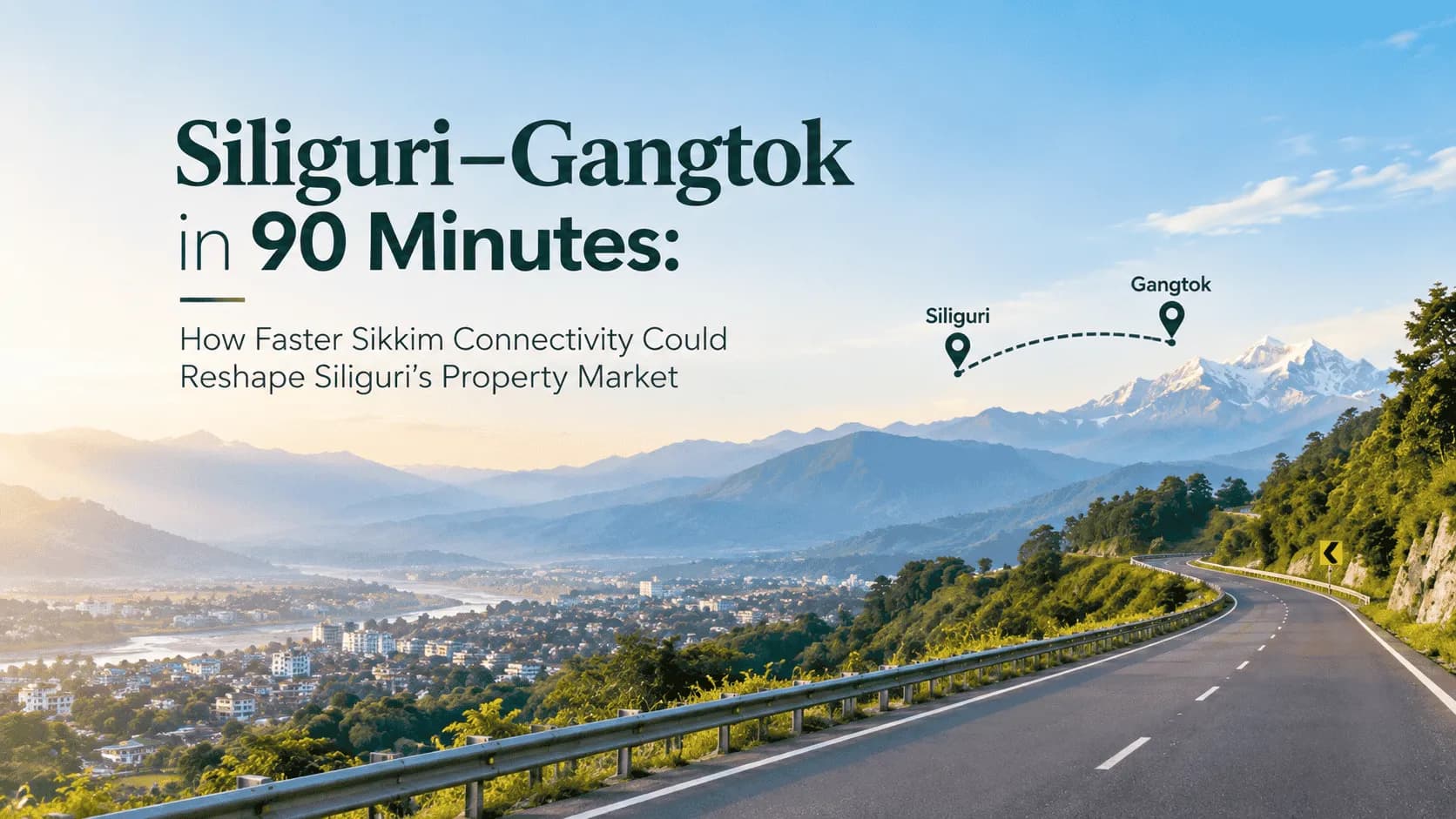
Siliguri–Gangtok in 90 Minutes: How Faster Sikkim Connectivity Could Reshape Siliguri's Property Market
A recent statement by Sikkim Roads & Bridges Minister N. B. Dahal has put the Siliguri–Gangtok connectivity story firmly back on the property map. At a press conference outlining ongoing road, bridge and highway projects, Dahal highlighted the potential for major improvements to Sikkim's connectivity, including the NH-210 Melli–Singtam project and the Sevoke–Melli road works.
The projected outcome is significant: the Siliguri–Gangtok journey, currently around four hours, could eventually fall to about 90 minutes if these planned connectivity improvements are delivered as intended.
For travellers, that means the hills could come closer. For Siliguri's property market, it raises a bigger question — what happens when the gateway to Sikkim becomes substantially faster and more connected?
📌 Honest frame first: the 90-minute figure is a projected target tied to projects currently at the DPR/development stage — a credible, significant plan, not a today-fact. We'll treat it as a strong medium-term tailwind to watch, not a promise. Timelines can shift.
📑 What This Guide Covers
What the minister actually announced
The three projects driving it
Why this matters more for Siliguri than for Sikkim
The gateway effect: how connectivity becomes property value
The 5 property effects for Siliguri
The corridor to watch — Sevoke Road & beyond
The honest caveats (buy smart)
What it means for you
1. What the Minister Actually Announced
Sikkim Roads & Bridges Minister N. B. Dahal outlined the state's ongoing and planned road, bridge and highway projects at a press conference, highlighting the potential for a major improvement in connectivity between Siliguri and Sikkim.
According to Minister Dahal, the Siliguri–Gangtok travel time could come down from around four hours to about 90 minutes as key infrastructure projects are completed. He specifically highlighted the NH-210 Melli–Singtam greenfield highway and the Sevoke–Melli road works as important projects that could significantly improve connectivity across the state
🛣️ Four-laning of NH-10 from Sevoke to Melli — upgrading the existing, congestion- and landslide-prone hill highway.
🆕 A new 23-km Melli–Singtam greenfield road, designated National Highway-210 (NH-210), awarded to NHIDCL, currently at the Detailed Project Report (DPR) stage — an alternative, faster alignment into Sikkim.
Together, these are designed to make the Siliguri–Gangtok run faster, safer and more reliable. And they don't stand alone.
📌 Important context: The ~90-minute travel time is a projected target cited by Sikkim Roads & Bridges Minister N. B. Dahal, based on the planned connectivity improvements. It is not today's travel time and should not be treated as a guaranteed outcome. Project timelines, alignments and implementation can change.
2. The Three Projects Driving It
The 90-minute road plan is part of a cluster of connectivity upgrades — which is what makes it credible:
Project | What it does | Status |
|---|---|---|
NH-10 four-laning (Sevoke–Melli) | Faster, safer main gateway highway | Underway/planned |
NH-210 (Melli–Singtam, 23 km greenfield) | New alternative route into Sikkim | DPR stage (NHIDCL) |
Sevoke–Rangpo railway | Sikkim's first-ever rail link; ~2 hr travel | Targeted ~2027 |
The Sevoke–Rangpo railway is the game-changer alongside the roads — the Sivok–Rangpo line ends at Rangpo (~10 km from Singtam), and NFR has already built 11 road-over-bridges and 26 road-under-bridges and removed 28 level crossings on the approach. Rail and road, arriving together, is a rare double upgrade (North Bengal infrastructure tracker, Siliguri infrastructure revolution).
3. Why This Matters More for Siliguri Than for Sikkim
Here's the insight most coverage misses. Faster access to Gangtok is wonderful for Sikkim — but the biggest, most durable economic beneficiary is Siliguri.
Why? Because every road and rail line to Sikkim passes through Siliguri. The city is the transit hub, the staging point, the supply base, the airport-and-railhead through which tourists, goods and workers flow up to the hills and back. When the pipe between Siliguri and Sikkim gets fatter and faster, more flows through it — and Siliguri captures the recurring, year-round economic base: hotels, transport, retail, logistics, services and homes.
Destinations get the visit. Gateways get the economy. Siliguri is the gateway — and this plan supercharges the gateway (why Siliguri is North Bengal's #1 destination, North Bengal 2026 complete guide).
4. The Gateway Effect: How Connectivity Becomes Property Value
The chain from a highway to a house price is simple and well-proven:
Faster connectivity → more tourism, trade & movement → more economic activity in Siliguri → more demand for hotels, shops, offices, homes & rentals → rising property values.
A 90-minute Gangtok run (plus a first-ever rail link) means more tourists choosing to base in or pass through Siliguri, more businesses serving the Sikkim trade, and more reasons to live and invest in the gateway city. That's exactly the mechanism that lifts real estate — and it's why this announcement is a property story, not just a transport one (hospitality boom, tea tourism, holiday homes in the hills).
5. The 5 Property Effects for Siliguri (The Positive Case)
If even part of this connectivity plan lands, here's how it flows into property:
🏨 A hospitality surge. More Sikkim-bound tourists = more demand for hotels, serviced apartments, homestays and hospitality real estate in Siliguri as the base camp (JW Marriott & branded hotels).
🏬Commercial & retail growth. Trade and tourism flowing through the gateway lift demand for shops, offices and retail (top commercial projects, retail & brand space).
🏠 Residential demand. More economic activity = more jobs = more people needing homes to buy and rent across Siliguri (best areas to buy, best 3 BHK flats).
🌱Land appreciation on the gateway corridors. Land along and near the Sikkim route re-rates as connectivity improves (plotted developments, emerging corridors).
💰Rental & holiday-let strength. Tourism-driven demand supports rentals and vacation-lets (rental yield in Siliguri).
💡 The positive read: a stronger Siliguri–Sikkim link doesn't just move people faster — it deepens Siliguri's whole economy, and property is where that deepening ultimately shows up.
6. The Corridor to Watch — Sevoke Road & Beyond
If connectivity is the story, Sevoke Road is the address. NH-10 to Sikkim begins on the Sevoke Road corridor — making it the physical artery of every one of these upgrades, and Siliguri's premium spine as the Sikkim gateway strengthens (Sevoke Road locality guide, Sevoke Road's commercial-retail rise, premium projects on Sevoke Road).
Beyond it, the airport belt and growth corridors that feed the tourism-and-trade economy stand to benefit too. Explore live options across these belts on SiliguriProperties.com projects — from premium Sevoke Road residences to planned plotting projects like Destinest Township, Shivmandir and Tulsi Vatika, Rangapani on the airport-side growth axis.
7. The Honest Caveats (Buy Smart)
A great macro story still demands property-level discipline:
⏳These are projects in progress, with DPR-stage and under-construction elements — treat the 90-minute target as upside, and buy on today's fundamentals (the complete 2026 investing roadmap).
🛣️Mind the highway setback rule. NH-facing land now faces the new setback norms — check before valuing frontage (the highway 40m/75m rulebook).
🌳Eco-sensitive zones near the hills (e.g. Mahananda belt) can restrict development — verify.
🧾 Verify every property — a connectivity boom can't fix a bad title (legal-safety verification, documents to check, property risk map).
8. What It Means for You
🏡 Homebuyers: a gateway city on a connectivity upswing is a city where your home holds and builds value — buy well, verify, hold.
📈Investors: position along the Sikkim-gateway corridors before the connectivity fully lands — stability today, structural upside tomorrow.
🏨 Businesses & developers: hospitality, commercial and quality housing demand should strengthen — plan for it (land, flat or commercial).
💰 Landlords: tourism-and-trade activity supports rental and holiday-let demand (rental yield).
🔑 Key Takeaways
🚗 Siliguri–Gangtok targeted to fall from ~4 hours to ~90 minutes (Sikkim minister).
🛣️How: NH-10 four-laning (Sevoke–Melli) + new NH-210 (Melli–Singtam, 23 km) + Sevoke–Rangpo railway (~2027).
🚪 Siliguri is the biggest winner — the gateway captures the recurring economy.
🏨 Property effects: hospitality, commercial, residential, land & rentals all lift.
🛤️ Sevoke Road is the corridor to watch — NH-10 to Sikkim begins here.
✅Buy on today's fundamentals, verify the property — treat the 90-minute target as upside.
👤 About the Author
Written by the SiliguriProperties Team — GFS Realtors' hyperlocal property resource for Siliguri & North Bengal, with 20+ years of combined experience connecting infrastructure news to on-ground property opportunity.
📚 Related Reads (Solve Every Related Query Here)
North Bengal's Hospitality Boom: Hotels Coming to Siliguri & Darjeeling
Holiday Homes & Investment Land in Darjeeling, Kalimpong & the Hills
Why Siliguri Is North Bengal's #1 Real Estate Investment Destination
The Highway 40m–75m Rulebook: What NH-facing Buyers Must Know
The Complete 2026 Roadmap to Investing in Siliguri Property (GFS)
🏡 Position for Siliguri's Sikkim-Gateway Boom — Today.
The connectivity is being built now. The smart entry point is now — in the right corridor, in a verified property.
👉 Explore Sevoke Road, gateway-corridor & verified properties on SiliguriProperties.com
📞 Talk to GFS Realtors — Sanat Trade Center, 1st Floor, Sevoke Road, Siliguri-01. Call +91 99320 66666. With 20+ years in this market, we help buyers and investors position along Siliguri's Sikkim-gateway corridors — and verify every property end-to-end before you commit.
This article is general market commentary based on infrastructure announcements and reports for 2026, for information only — not investment, legal or financial advice. The 90-minute travel-time figure is a projected target tied to projects at the DPR/development stage; timelines and outcomes can change. Property returns are not guaranteed and depend on the specific property, price, timing and diligence. Always verify a property's legal status, applicable rules (including highway setback and eco-sensitive zones) and approvals with the relevant authorities and a qualified lawyer before investing.