Mahananda Wildlife Sanctuary’s Revised ESZ Draft 2026: 1 km to 18.16 km Buffer, Affected Areas, Land Restrictions & What Property Owners Should Know

GFS Realtors
We provide deep market insights and strategic advice for real estate buyers, sellers, and investors.
Expert at providing deep market insights and strategic advice for real estate
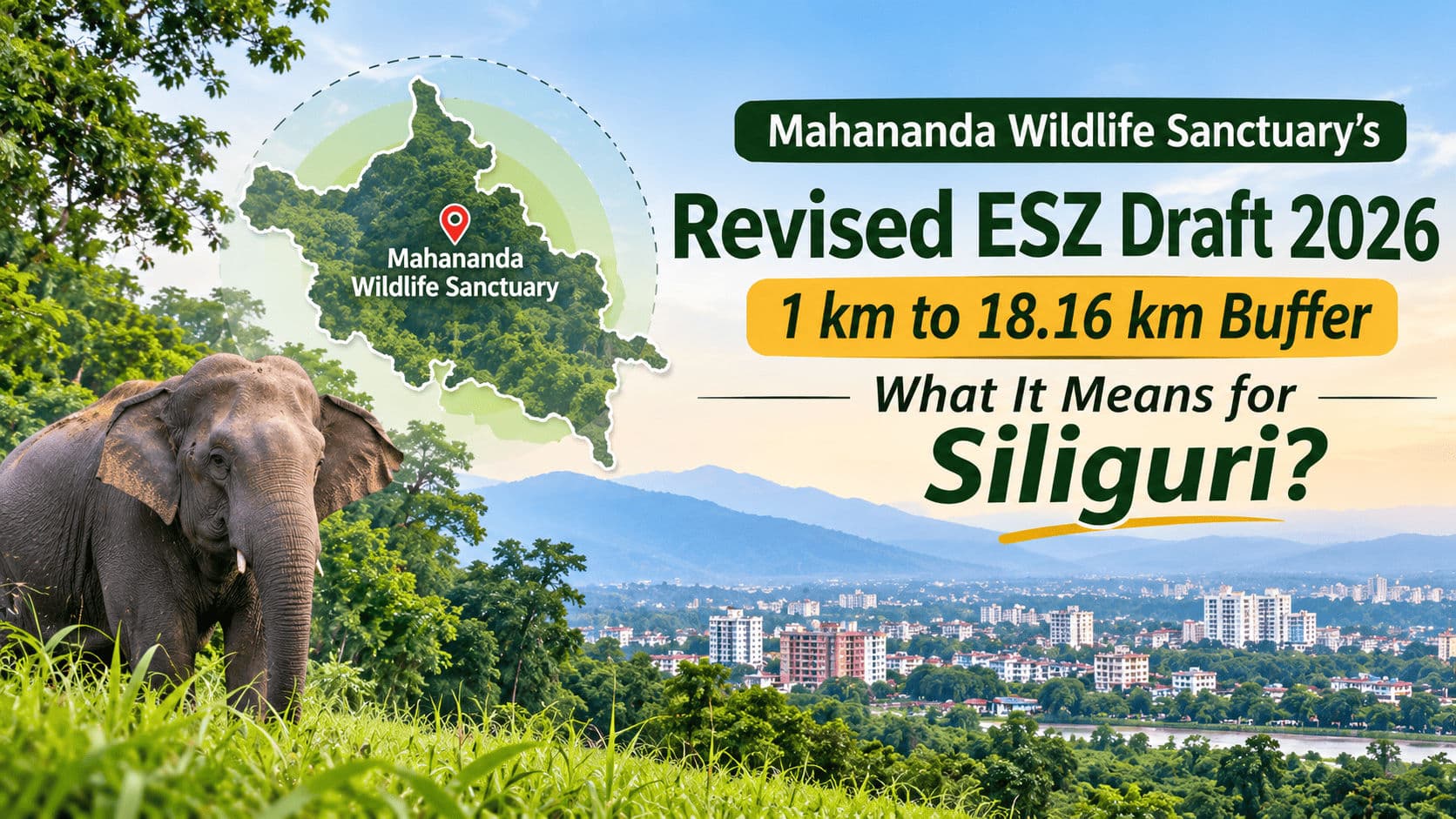
Mahananda Wildlife Sanctuary’s Revised ESZ Draft 2026: 1 km to 18.16 km Buffer, Affected Areas, Land Restrictions & What Property Owners Should Know
Understanding the new ESZ rules: what every landowner and property buyer in North Bengal should know before investing.
Direct answer: In late October 2026, the Union Ministry of Environment, Forest and Climate Change (MoEFCC) published a revised draft Eco-Sensitive Zone (ESZ) notification for the Mahananda Wildlife Sanctuary (Gazette reference S.O. 5816(E), issued 27 October, published 28 October 2026). It proposes replacing the earlier uniform 5 km zone with a variable buffer ranging from 1 km to 18.16 km, expanding the total ESZ to 539.86 sq km and touching 31 revenue villages, 24 tea gardens and 14 forest areas around Siliguri. Here’s the part that matters: this is not simply “more restrictions everywhere.” In some prime Siliguri-facing pockets the buffer shrinks to 1 km, while in the tea-growing and elephant-corridor belt it extends dramatically. If you own or plan to buy land in or near this zone, this guide explains exactly what it means — and what to do. Remember throughout: this is a draft, open to public objections, not a final law.
First, the Basics: What Is an Eco-Sensitive Zone (ESZ)?
An Eco-Sensitive Zone is a buffer area around a national park or wildlife sanctuary, notified under the Environment (Protection) Act, 1986, to act as a “shock absorber” between the strictly protected core and the busier human landscape outside. The idea is simple: regulate (not necessarily ban) activities close to a sanctuary so that wildlife, forests and corridors aren’t degraded by unchecked development right at their edge.
Crucially, an ESZ is not a no-go zone. It works on a three-tier activity system — some activities are prohibited, some are regulated (allowed only with permission), and many everyday ones remain permitted. The precise rules for each ESZ are eventually fixed in a Zonal Master Plan (ZMP) prepared after the notification is finalised.
The Mahananda ESZ Story: How We Got Here
This isn’t the first notification — it’s the latest step in a multi-year process. Understanding the timeline is key to understanding the 2026 draft:
Stage | Notification | Buffer | Total Area | Coverage |
|---|---|---|---|---|
2020 | S.O. 3237(E) | Uniform 5 km | 405.28 sq km | 79 revenue villages, 16 tea gardens, 6 forest areas |
2024 (draft) | S.O. 3832(E) | Variable (proposed) | Expanded | Revision proposed |
2026 (revised draft) | S.O. 5816(E) | 1 km – 18.16 km | 539.86 sq km | 31 revenue villages, 24 tea gardens, 14 forest areas |
Two things jump out:
The buffer is now variable, not uniform. Instead of a flat 5 km ring, the 2026 draft draws the boundary tighter in some places (down to 1 km) and much wider in others (up to 18.16 km), following ecological logic — especially elephant corridors.
The total area grew (405.28 → 539.86 sq km), yet the number of revenue villages fell (79 → 31) while tea gardens (16 → 24) and forest areas (6 → 14) rose — reflecting the shift toward protecting tea-belt corridors rather than a uniform ring.
Our earlier explainer, Mahananda Eco-Sensitive Zone Cut from 5 km to 1 km: What It Means for Siliguri Real Estate, covered the relief side of this story; this revised draft adds the fuller, more nuanced picture.
The 2026 Revised Draft — Key Facts at a Glance
Item | Detail |
|---|---|
Issued by | MoEFCC (Union Environment Ministry) |
Gazette reference | S.O. 5816(E) |
Issued / published | 27 Oct 2026 / 28 Oct 2026 |
Buffer range | 1 km to 18.16 km (variable) |
Total ESZ area | 539.86 sq km |
Coverage | 31 revenue villages · 24 tea gardens · 14 forest areas |
Primary purpose | Protect wildlife and elephant corridors |
Status | Draft — open to public objections |
Objection window | 60 days from the date the gazette is made available to the public |
A note on precision: most reporting cites the maximum buffer as 18.16 km; one source lists it as 18.6 km. Always rely on the official gazette (S.O. 5816(E)) for the exact figure that applies to a specific parcel.
Which Areas Are Affected?
The ESZ is concentrated in the tea-growing belt and forest corridors around the sanctuary. Reported coverage and flashpoints include:
Tea estates across the Terai belt — the heart of the opposition, as 24 tea gardens fall within the proposed zone.
Salbari and the Siliguri Eastern Bypass area — flagged for elephant movement, where wider buffers are proposed.
31 revenue villages and 14 forest areas within the variable boundary.
Notably, tea planters allege that some “prime real estate areas” near Siliguri were excluded (kept at the 1 km minimum), which is partly why the impact is uneven. Because the boundary is variable and parcel-specific, two plots a few kilometres apart can face completely different rules — which is exactly why individual verification matters (more below).
What Can and Can’t Be Done in an ESZ? The Activity Framework
The specific do’s and don’ts for Mahananda will be finalised in its Zonal Master Plan, but ESZ notifications across India follow a standard three-tier structure. Here’s the general framework to understand how restrictions work:
Category | Typical Activities |
|---|---|
🚫 Prohibited | Commercial mining, stone quarrying & crushing; polluting industries; major hydroelectric projects; commercial sawmills; new polluting units; use of or production of hazardous substances |
⚠️ Regulated (permission needed) | New commercial construction, hotels & resorts; felling of trees; widening of roads; large-scale commercial establishments; discharge of effluents; change of land use (within limits) |
✅ Permitted | Ongoing agriculture & horticulture by locals; rainwater harvesting; organic farming; renewable energy; existing dwellings and local amenities |
The key takeaways for property owners:
An ESZ does not automatically freeze all development — much depends on which tier your intended use falls in and how close you are to the sanctuary.
Tourism and hospitality (highly relevant to the tea belt) usually fall under regulated, needing clearances — which is at the heart of the tea-tourism dispute.
Existing homes and farming generally continue, but new commercial or large-scale projects face scrutiny.
These are the general ESZ categories for understanding only. The binding list for Mahananda is whatever the final notification and Zonal Master Plan specify — always confirm officially.
The Nuanced Impact: Relief for Some, Restriction for Others
This is where most coverage oversimplifies. The 2026 draft produces a genuinely mixed outcome:
Where it eases things 🟢
Prime Siliguri-facing pockets reportedly kept at the 1 km minimum gain more development certainty than under the old uniform 5 km ring.
A tighter, logic-based boundary can remove ambiguity for parcels well outside the corridor.
Where it tightens things 🔴
Tea estates and the elephant-corridor belt face buffers extending up to 18.16 km, constraining new commercial, tourism and construction activity.
The tea-tourism model — which depends on building experiential stays on estate land — collides directly with the wider buffers.
So the honest reading is: location within the zone is everything. The same draft can be good news for one plot and a serious constraint for another.
Green vs Growth: The Debate Behind the Draft
The draft has triggered a real conservation-versus-development clash:
The conservation case: Mahananda sits on critical elephant corridors linking forest habitats; uncontrolled construction at the edge fragments these corridors and raises human–wildlife conflict. Wider, corridor-aligned buffers protect biodiversity.
The tea industry’s case: Associations including the Terai Indian Planters’ Association and Darjeeling Tea Association oppose the draft, arguing it undermines the West Bengal Tea Tourism & Allied Business Policy, 2019, threatens jobs, and unfairly targets tea regions. Their chairman has argued the Tea Tourism Policy “should take precedence over general ESZ regulations.”
Stakeholder meetings followed — the Siliguri Mayor met tea associations (Jan 2025), and a committee was formed with the Chief Conservator of Forests, Wildlife North to deliberate. The outcome of this tension will shape the final notification. For the tea-tourism context, see Tea Tourism & the Rise of Tea-Garden Hotels in Siliguri & North Bengal and Holiday Homes & Investment Land in Darjeeling, Kurseong, Kalimpong & Mirik.
What Property Owners & Buyers Should Do — A Practical Checklist
This is the most important section. Here’s exactly how to protect yourself:
1. Find out if your land falls in the ESZ — and at what buffer.
Don’t assume. Because the boundary is variable, check the specific parcel against the draft notification’s maps and mouza/village list.
2. Verify the land records and location precisely.
Confirm khatian/RS-LR records, ULPIN, and exact coordinates. Our guides: Land Mutation (Namjari) in West Bengal and Documents Required to Buy a Flat or Land in Siliguri.
3. Check land-use classification and intended activity.
Whether you plan a home, a resort or a commercial project determines which ESZ tier applies. Confirm land-use conversion status before assuming you can build.
4. Consult the Forest Department and local authority.
For land inside or near the zone, get written clarity from the relevant forest/SJDA/SMC office before committing.
5. If affected, file an objection within the 60-day window.
The draft invites public comments for 60 days from gazette availability. Landowners and associations can submit objections/suggestions to the MoEFCC through the stated channel — this is your legal right to be heard.
6. Build ESZ checks into your purchase agreement.
Make clear title, land-use and ESZ status conditions of sale. See How to Read an Agreement for Sale, WBRERA Explained, and our full guide How to Verify a Property Is 100% Legally Safe Before You Buy in Siliguri.
7. Get professional advice for any significant parcel.
For tea-estate, large-land or commercial transactions near the sanctuary, engage a qualified legal/revenue professional. The GFS West Bengal Real Estate Reforms 2026 gives the wider regulatory backdrop.
This is general information, not legal advice. ESZ status can make or break a project — always verify a specific parcel’s position and permissible uses with the Forest Department and a qualified professional before buying or building.
Important: It’s a Draft, Not a Final Law
Keep this front of mind. A draft ESZ notification is a proposal. It goes through public objections (60 days), review, possible revision, and a final notification before it becomes binding — and the buffer, area and activity list can change in that process, as the 2020 → 2024 → 2026 evolution shows. Don’t make irreversible decisions on draft figures alone, and don’t panic-sell or rush-buy on headlines. Track the final notification and the eventual Zonal Master Plan.
🔑 Key Takeaways
🗺️ Revised draft ESZ (S.O. 5816(E), Oct 2026) proposes a variable 1 km–18.16 km buffer over 539.86 sq km.
🌳 Replaces the old uniform 5 km zone (405.28 sq km) — area grew, but the boundary now follows elephant corridors.
🏘️ Affects 31 revenue villages, 24 tea gardens, 14 forest areas near Siliguri.
⚖️ Impact is mixed — some prime Siliguri pockets eased to 1 km; the tea/corridor belt tightened to up to 18.16 km.
🚫 ESZ ≠ no-build — it’s a three-tier system (prohibited / regulated / permitted); specifics come in the Zonal Master Plan.
🌿 Green vs Growth — conservation (elephant corridors) vs tea tourism is the core tension.
📝 It’s a draft — 60-day objection window; verify your parcel and, if affected, file objections.
👤 About the Author
Written by the Siliguri Properties Team — a hyperlocal resource for Siliguri & North Bengal, helping landowners and buyers understand the rules, records and regulations that shape property decisions in the region.
📚 Related Reads (Understand the Full Picture)
Mahananda Eco-Sensitive Zone Cut from 5 km to 1 km: What It Means for Siliguri
How to Verify a Property Is 100% Legally Safe Before You Buy in Siliguri
How to Read an Agreement for Sale: Clauses Every Buyer Must Check
Tea Tourism & the Rise of Tea-Garden Hotels in Siliguri & North Bengal
Holiday Homes & Investment Land in Darjeeling, Kurseong, Kalimpong & Mirik
📌 Buying or Owning Land Near Mahananda? Verify First.
ESZ rules can make or break a land decision — and with a variable 1 km–18.16 km buffer, the only safe approach is parcel-level verification. Don’t rely on headlines or assumptions.
👉 Check locality, land records and legal status with SiliguriProperties.com and GFS Realtors.
📞 Talk to GFS Realtors — Sanat Trade Center, 1st Floor, Sevoke Road, Siliguri-01. Call +91 99320 66666. With 20+ years in North Bengal’s land market, we help buyers verify ESZ status, title and permissions end-to-end before they commit.
This article is general information based on the revised draft Eco-Sensitive Zone notification (S.O. 5816(E)) for the Mahananda Wildlife Sanctuary, published by the MoEFCC in October 2026, and related reporting — for understanding only, not legal, investment or financial advice. The notification is a draft and subject to objections, revision and a final notification; buffer figures, boundaries and activity rules may change. Activity categories described are the general ESZ framework; the binding rules for Mahananda are those in the final notification and Zonal Master Plan. Always verify a specific parcel’s ESZ status and permissible uses with the Forest Department and a qualified professional before buying or building.