Adani Group Eyes North Bengal Ropeway Projects: Could Darjeeling–Kurseong Connectivity Transform Tourism, Infrastructure & Real Estate in 2026?

GFS Realtors
We provide deep market insights and strategic advice for real estate buyers, sellers, and investors.
Expert at providing deep market insights and strategic advice for real estate
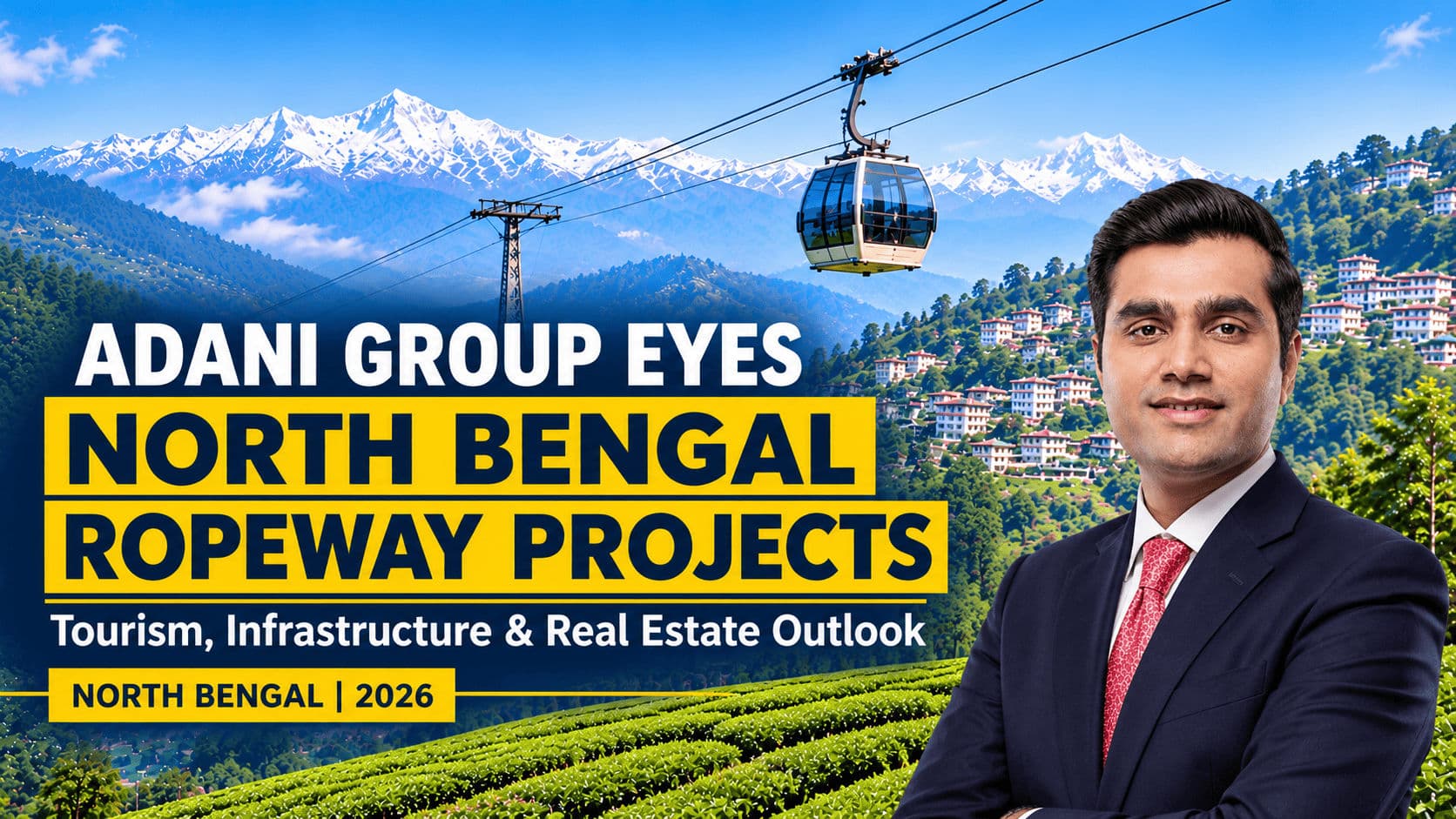
Adani Group Eyes North Bengal Ropeway Projects: Could Darjeeling–Kurseong Connectivity Transform Tourism, Infrastructure & Real Estate in 2026?
A major corporate name has entered North Bengal's connectivity story. Explore how the Adani Group's interest in the proposed Darjeeling–Kurseong ropeway could reshape hill tourism, strengthen infrastructure and influence real estate across the region in 2026.
Direct answer: The Adani Group has expressed interest in the proposed Darjeeling–Kurseong ropeway — a roughly 25–30 km aerial link estimated at around ₹3,000 crore, which could cut a road journey that takes 4–5 hours in peak season down to about 45 minutes. Group leadership flagged ropeways among its "next big bets" in Bengal at the ET Bengal Ascends summit, putting serious corporate weight behind an idea that has long been discussed. Crucially, the project is still at the proposal / feasibility stage — route, investment and timelines aren't finalised — but the entry of a large infrastructure player is a significant signal. This guide lays out everything known so far and what it could mean for tourism, infrastructure and real estate.
⚡ Quick Facts — The Proposed Darjeeling–Kurseong Ropeway
Item | Detail |
|---|---|
Corporate interest | Adani Group (interest expressed) |
Route | Kurseong ↔ Darjeeling, North Bengal |
Proposed length | ~25–30 km (existing road stretch ~32 km) |
Estimated cost | ~₹3,000 crore |
Likely model | BOOT (Build–Own–Operate–Transfer) |
Travel time | ~45 minutes (vs 4–5 hours by road in peak season) |
Stations | ~4–5 stations serving tourist/popular points |
Capacity (preliminary) | ~800–1,800 passengers/hour |
Status | Proposal / feasibility stage — details to be finalised |
Context | State to invite private players; possible central support |
📰 What's the News?
At the ET Bengal Ascends summit, Adani Group leadership outlined the group's "next big bets" in West Bengal — spanning ropeways to ring roads — and the Darjeeling–Kurseong ropeway emerged as a project the group has shown interest in developing.
This matters because the ropeway has been discussed as a state-backed idea for some time, with the government expected to invite private players to build it, likely under a BOOT (Build–Own–Operate–Transfer) model. The possibility of a large, experienced infrastructure developer stepping in moves the conversation from "nice idea" toward "potentially buildable project."
Important — read this clearly: As of now, this is interest in a proposed project at the feasibility stage, not an awarded contract or a confirmed build. Route, final cost and timelines are yet to be locked. We'll treat it as a promising signal, not a done deal.
🚡 Why a Ropeway? The Problem It Solves
Anyone who has driven the hills knows the pain: the main road link between Kurseong and Darjeeling — NH-110 (Hill Cart Road) — can crawl for 4 to 5 hours during peak tourist season, choked by traffic, landslides and sheer volume. For a region whose economy runs on tourism, that's a serious handicap.
A ropeway flips the equation:
⏱️ ~45 minutes instead of 4–5 hours — a dramatic time saving.
🚗 Fewer vehicles on the road — easing congestion on Hill Cart Road.
🌧️ Weather & landslide resilience — an aerial route is less exposed to road blockages.
🏔️ An experience in itself — gliding over tea gardens and hills becomes a tourist attraction, not just transport.
The state has even floated night-time cable transport of food grains and vegetables to cut daytime truck traffic — showing the ropeway is being imagined as real infrastructure, not just a tourist ride.
🏔️ Potential Impact #1: Tourism
Tourism is where the ropeway could hit hardest — in the best way:
More visitors, more often — faster, more predictable travel makes short trips and day visits viable, lifting footfall across Darjeeling, Kurseong and the stops in between.
A marquee attraction — a scenic hill ropeway is itself a draw, adding to the region's appeal.
Spread-out tourism — with 4–5 stations, smaller towns along the route could see new visitor interest, not just the big destinations.
Longer season — reducing weather/road dependence helps smooth the sharp peaks and troughs of hill tourism.
This connects directly to the region's wider tourism momentum — see North Bengal's Hospitality Boom: Every Major Hotel Brand Coming.
🏗️ Potential Impact #2: Infrastructure
The ropeway would be one piece of a broader North Bengal connectivity upgrade already in motion — Bagdogra airport expansion, NH-10 slope-protection and upgrades, NH-327 four-laning, and more. A high-profile ropeway adds an aerial layer to this network and signals that private capital sees the region as investable. When large developers back a region's infrastructure, it often catalyses further investment. Track the full picture in the North Bengal Infrastructure Tracker and Siliguri's Infrastructure Revolution.
🏡 Potential Impact #3: Real Estate
Better connectivity is one of the most consistent long-term drivers of property demand — and a transformational ropeway could influence real estate on two fronts:
In the hills (Darjeeling, Kurseong & station points): Stronger tourism and access can lift demand for homestays, boutique hotels, holiday homes and hospitality-linked property near the stations.
At the gateway (Siliguri): Every boost to hill tourism and connectivity reinforces Siliguri's role as the base city
— the launch pad for the hills — supporting demand for residential, commercial and hospitality real estate. Understand the gateway logic in Siliguri's Best Localities to Invest In: A Data-Driven Ranking and the GFS
A note of realism: hill real estate carries special rules (land-use, slope, heritage and environmental norms), so any investment there needs extra due diligence — see How to Verify a Property Is Legally Safe.
🌐 Part of a Bigger Ropeway Vision
The Darjeeling–Kurseong line isn't the only one on the table. The state is also reportedly considering a Kalimpong–Gangtok ropeway, pointing to a broader ambition to make aerial connectivity a signature of the Eastern Himalayas. If even one marquee project is delivered well, it could pave the way for a network — a genuine shift in how people move through the hills.
⚖️ Honest Caveats
Keep expectations grounded:
It's interest, not a contract. Adani has expressed interest in a proposed project; nothing is awarded or confirmed.
Feasibility stage. Route, final cost (~₹3,000 cr is an estimate), capacity and timelines are yet to be finalised.
Big projects take time. Even once cleared, ropeways of this scale take years to build.
Approvals & terrain. Hill, forest, environmental and land clearances are complex and can affect scope and schedule.
Real-estate impact is gradual. Connectivity benefits build over years and depend on actual delivery.
The direction is genuinely exciting — but the smart reader tracks progress rather than assuming completion.
🔑 Key Takeaways
🚡 Adani Group has expressed interest in the proposed Darjeeling–Kurseong ropeway — flagged among its "next big bets" in Bengal.
💰 ~₹3,000 crore, ~25–30 km, BOOT model, ~4–5 stations, ~800–1,800 passengers/hour (all preliminary).
⏱️ ~45 minutes vs 4–5 hours by road in peak season — a potential game-changer for hill travel.
🏔️ Tourism could gain the most — more visitors, a marquee attraction, and a longer, more reliable season.
🏗️ Infrastructure — adds an aerial layer to North Bengal's connectivity push and signals private-capital confidence.
🏡 Real estate — could lift hill hospitality/holiday-home demand and reinforce Siliguri as the gateway.
⚖️ Still a proposal — interest at feasibility stage, not a confirmed build; track delivery before assuming impact.
👤 About the Author
Written by the Siliguri Properties Team — a hyperlocal resource for Siliguri & North Bengal, turning major infrastructure and investment news into clear, grounded insights for residents and investors.
📚 Related Reads
North Bengal's Hospitality Boom: Every Major Hotel Brand Coming
Siliguri's Infrastructure Revolution: What's Changing & Why It Matters
Bagdogra Airport Expansion: Which Siliguri Localities Benefit Most
Siliguri's Best Localities to Invest In: A Data-Driven Ranking
How to Verify a Property Is 100% Legally Safe Before You Buy
Why Investing in Plots in Siliguri Is One of the Smartest Moves in 2026
🏡 As North Bengal Connects, the Gateway Grows
Whether or not the ropeway flies, the message is clear: big players see North Bengal as the next frontier — and Siliguri, as the region's gateway, stands to benefit from every connectivity leap. The time to understand the market is before the headlines become concrete.
👉 Explore land, plots, flats & commercial opportunities across Siliguri & North Bengal on SiliguriProperties.com and GFS Realtors.
📞 Talk to GFS Realtors — Sanat Trade Center, 1st Floor, Sevoke Road, Siliguri-01. Call +91 99320 66666. With 20+ years in North Bengal's market, we help you read the region's momentum and make well-verified property decisions.
This article is general informational content based on reported statements and coverage regarding the Adani Group's expressed interest in the proposed Darjeeling–Kurseong ropeway and related North Bengal infrastructure, for awareness purposes only. The project is at the proposal/feasibility stage; the route, cost (~₹3,000 crore is an estimate), capacity, developer and timelines are not finalised and are subject to change. Expressed interest does not constitute an awarded contract or confirmed construction. This is not investment or legal advice. Property outcomes depend on delivery, location, title and price, and are not guaranteed. Always verify current project status with official sources and consult a qualified professional before making decisions.