

North Bengal: Connectivity, Capital & the Making of a New Growth Region
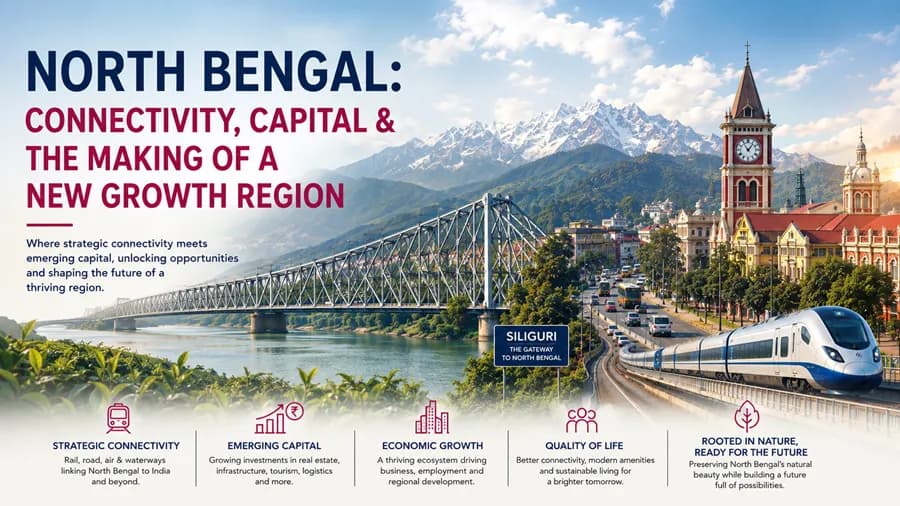
North Bengal: Connectivity, Capital & the Making of a New Growth Region
Access the complete data, detailed analysis, and comprehensive market breakdowns in our official PDF report.
NORTH BENGAL
MARKET INSIGHTS REPORT
Connectivity, Capital & the Making of a New Growth Region
Rail, Road & Air Connectivity • Hospitality & Tourism • Industrial & Logistics • Policy Tailwinds • Micro-Market Outlook
1. Executive Summary
North Bengal — anchored by Siliguri and extending into the hill towns of Darjeeling, Kalimpong and Mirik, and the forests of the Dooars — is in the middle of the most concentrated wave of infrastructure and capital investment the region has seen in a generation. A new international-grade airport terminal, multiple rail and expressway corridors, a fast-maturing industrial and logistics base, and a hospitality boom pulling in nearly every major hotel brand in India are all converging on the same geography, at the same time.
This report consolidates the market intelligence GFS Realtors and siliguriproperties.com have researched and published across our blog content through 2026, together with the infrastructure and policy findings from our companion Siliguri Market Insight Report, into a single regional view. It is organised around five forces reshaping North Bengal real estate: connectivity (rail, road and air), the hospitality and tourism boom, industrial and logistics growth, integrated township development, and the policy tailwinds following the change in state government — closing with a snapshot of micro-market performance and corridor-level investment guidance.
2. The Connectivity Revolution
Three simultaneous transport upgrades — air, rail and road — are compressing North Bengal's distance from the rest of India and from its own hill and forest hinterland. Historically, real estate re-rates fastest in the years immediately around this kind of infrastructure delivery, and North Bengal is now inside that window.
2.1 Bagdogra Airport — A 3x Capacity Transformation
• Scale: the ongoing expansion is the single most consequential infrastructure project in the region's real estate history, being delivered in two phases — a 70,400 sq m terminal first, followed by runway and taxiway upgrades, with a second phase adding a further 50,000 sq m.
• Capacity: hourly handling capacity rises from roughly 400 to 3,000–3,800 passengers, and annual capacity grows from about 3.2 million to up to 10 million — a threefold increase, with a net-zero green terminal design.
• International reach: Bagdogra's Point of Call (PoC) status already permits direct international flights, making routes to Dhaka, Kathmandu, Thimphu and Bangkok realistic medium-term additions once capacity comes online.
• Real estate impact already visible: properties within 10 km of the airport have already appreciated 40–60%, and Matigara — 17 minutes from the terminal, the shortest airport commute of any major Siliguri locality — has appreciated 43.6% over five years.
2.2 Rail: Doubling, High-Speed Rail and the Sikkim Line
• NJP–Siliguri doubling: Indian Railways has approved doubling of the New Jalpaiguri–Siliguri line, resolving a long-standing capacity bottleneck on one of North Bengal's busiest feeder routes.
• Delhi–Varanasi–Siliguri High-Speed Rail Corridor: the 2026–27 Union Budget included the Delhi–Varanasi–Siliguri corridor among seven new high-speed rail lines nationally, with the Varanasi–Siliguri leg envisaging under three hours' travel time and seamless onward connectivity to Delhi. Stations on high-speed corridors have historically become hubs for commercial and hospitality development.
• Siliguri–Sikkim Railway Line: targeted for completion in 2027, this line will cut Siliguri–Gangtok travel time to about two hours. Properties near proposed station corridors are already commanding a 30–50% pricing premium in anticipation.
2.3 Road: Expressways and Highway Fast-Tracking
• Kolkata–Siliguri Expressway: a four-lane, roughly 675-km corridor linking Kolkata to Siliguri is being developed with central funding of approximately Rs. 25,000 crore, intended to sharply cut South–North Bengal travel time.
• Gorakhpur–Siliguri Expressway: a proposed Rs. 30,000 crore expressway that would further strengthen Siliguri's position as North-East India's principal distribution gateway.
• Highway transfer to central agencies: the state government has transferred seven key highway stretches near the Siliguri Corridor — including NH-31, NH-33, NH-312, the Sevok–Coronation Bridge route, and the Hasimara–Jaigaon and Changrabandha connectivity projects — to NHAI and NHIDCL, clearing a long-pending execution deadlock.
• NH-27 & Siliguri–Jalpaiguri corridor: continued four-laning of NH-27, together with the four-lane Siliguri–Jalpaiguri highway, is expanding the catchment area for Siliguri's residential, commercial and industrial markets.
Sources: Indian Railways and Ministry project approvals; Union Budget 2026–27 announcements; state infrastructure press coverage; siliguriproperties.com blog research (2026). Timelines for high-speed rail and expressway projects are indicative and subject to revision during detailed project reports and land acquisition.
3. Hospitality & Tourism: North Bengal's Branded Hotel Boom
Nearly every major Indian and international hotel brand is now present, under construction, or formally signed across Siliguri and the hill and forest circuits beyond it — a scale of institutional hospitality investment North Bengal has not previously seen. Ambuja Neotia Group alone has announced an investment plan exceeding Rs. 15,000 crore across West Bengal over five years, spanning hospitality, healthcare, tourism and residential and commercial real estate, including a Rs. 1,200 crore, seven-hotel Taj-branded luxury circuit adding 600 five-star rooms across destinations including Darjeeling and Kalimpong, and two convention hotels (Kolkata and Siliguri) totalling 800 rooms at a further Rs. 1,500 crore.
3.1 Siliguri City — Multi-Brand Entry
• DoubleTree by Hilton: signed for Sevoke Road, alongside ITC Mementos at Dagapur Tea Estate, Mercure by Accor, and a Radisson Blu planned within the ~700,000 sq ft Crossroads Mall mixed-use development at Uttorayon by SKA Lumina Developers.
• Lemon Tree & Hyatt: multiple Lemon Tree properties are confirmed across Siliguri and Mirik; Hyatt has been referenced as a planning-stage entrant but had not made a formal signed announcement as of mid-2026 and should be tracked rather than assumed.
• Mayfair Tea Resort (Chumta) & Taj Chia Kutir (Kurseong): already operational, with ITC Fortune also an established presence — both demonstrating early-mover confidence that the current wave of signings is now scaling.
3.2 The Hills and the Dooars
• Darjeeling: beyond the operational Taj Chia Kutir, the Ambuja Neotia–Taj circuit and Keys Prima by Lemon Tree add a full suite of internationally branded luxury properties through 2030.
• Kalimpong: ITC Hotels has confirmed a Welcomhotel here, signalling that even smaller, quieter hill towns are being brought into the formal branded hospitality ecosystem — positioned for boutique luxury and wellness tourism.
• Dooars (Lataguri): a Tree of Life hotel is planned for Lataguri under the IHCL–Ambuja Neotia partnership, targeting the fast-growing eco-tourism and wildlife safari market around Gorumara, Jaldapara and Buxa Tiger Reserve — a segment that remains dramatically undersupplied with branded eco-lodges relative to demand.
• Mirik: the confirmed signing of a 50-room Lemon Tree Resort — with pool, fitness centre, banquet hall and bar — has elevated this lakeside town from home-stay territory into branded-hospitality conversation, with land near Sumendu Lake and the surrounding tea estates now attracting serious investor interest.
3.3 What's Driving It: Weddings, Wildlife & a $3,000 GDP Threshold
India crossing the $3,000 per-capita GDP mark is historically the threshold at which a hospitality boom accelerates — and branded room supply in North Bengal has not yet caught up with underlying demand. A significant driver is the destination wedding market: a single large wedding can book 100+ rooms and multiple banquet halls for three days, creating an outsized multiplier effect on local hospitality, catering, transport and retail. Siliguri is increasingly the preferred North-East gateway destination for this market from Bihar, Bengal, Jharkhand and beyond, and branded hotel entry is compounding this trend rather than merely following it.
Hotel-brand information reflects siliguriproperties.com blog research current to mid-2026, drawn from company announcements and press coverage; unconfirmed or planning-stage entrants (noted above) should be independently verified before being relied upon commercially.
4. Industrial & Logistics Growth
Siliguri's role as the multimodal gateway to the North-East, Nepal, Bhutan and Bangladesh is now attracting national institutional developers, not just local trading capital — a maturing signal for any regional property market.
• TVS Industrial & Logistics Parks (TVS ILP): India's leading industrial park developer entered Siliguri in 2024 with a 5.66-acre, 1.40 lakh sq ft Grade A facility in Fulbari (Rs. 50 crore), let to an e-commerce major, followed in May 2026 by a second MoU for a further 10-acre logistics facility — explicit institutional validation of the corridor within an 18-month span.
• Webel IT Parks: multiple IT park phases operated by the West Bengal Electronics Industry Development Corporation sustain a technology employment base that supports rental demand in nearby residential localities.
• Cross-border trade routes: the Fulbari–Banglabandha corridor (Bangladesh), Panitanki (Nepal) and Jaigaon (Bhutan) give Siliguri direct cross-border trade access unmatched by any other East Indian city, positioning it as the natural distribution base for regional commerce.
4.1 Six Industrial & Warehousing Corridors
Our locality-level research (2026) identifies six corridors as the core of Siliguri's industrial and warehousing map: Fulbari (the established anchor, hosting TVS ILP, with land priced around Rs. 8–18 lakh per Katha and roughly 35–40% appreciation over three years), Eastern Bypass, the Siliguri–Jalpaiguri Highway corridor, Balaram, Liechupukhri, and Ghoshpukur. Key occupier categories across these corridors include e-commerce, FMCG distribution (including Adani Wilmar and HUL-linked distributors), pharma cold-chain, tea trading, and construction-material stockyards — with land pricing across the six corridors still meaningfully below comparable logistics hubs such as Pune, Gurugram or even Kolkata.
5. Integrated Townships: The Uttorayon Precedent
Uttorayon, developed by the Ambuja Neotia Group in joint venture with Luxmi Township Ltd on the former Chandmoni Tea Estate, was Siliguri's first integrated township when it launched around 2005 on nearly 400 acres along the Asian Highway near Matigara. It is instructive for how infrastructure-led, professionally planned development re-rates a market: land that started as an unproven bet on an abandoned tea garden is now priced at roughly Rs. 70–80 lakh per Katha, with apartments around Rs. 7,000–8,000 per sq ft — among the highest in Siliguri — and the township has since added a mall, an office block, a multi-specialty hospital and schools.
• What's coming next: the ~700,000 sq ft mixed-use development by SKA Lumina Developers, which will house Siliguri's first Radisson Blu — both under development as of 2026.
The broader lesson for today's buyers is that Siliguri's next Uttorayon-style opportunity is unlikely to look obvious at launch. The professionally planned, amenity-anchored corridors gaining institutional and hospitality-brand attention today — airport-corridor localities, the Sevoke Road lifestyle stretch, and emerging industrial belts — are the closer analogues to where Uttorayon stood two decades ago.
6. Policy Tailwinds: A Change of Government
The 2026 West Bengal Legislative Assembly election ended the Trinamool Congress's fifteen-year tenure, with the Bharatiya Janata Party winning a majority and Suvendu Adhikari sworn in as Chief Minister on 9 May 2026. This is the first change of ruling party in the state since 2011, and it is already visible in faster Centre-State project execution — most notably the state's transfer of seven national highway stretches near the Siliguri Corridor to central agencies within months of the change of government.
• Investment sentiment: real estate investment pledges exceeding Rs. 28,000 crore were reported within the first two months of the new government, alongside stated plans for land reform, amendments to the West Bengal Land Reforms Act and Land Reforms Tribunal Act, and continued digitisation of land records via the Banglarbhumi portal.
• “Himalayan Hill Cities” proposal: a proposed Rs. 1,000 crore Hill and Himalayan Cities Focused Fund under Swachh Bharat Mission-Urban 2.0, and the wider Rs. 1 lakh crore Urban Challenge Fund framework, have been floated as potential central support for hill-town infrastructure covering 13 Himalayan states; the framework is broader than Siliguri, Darjeeling, Kalimpong, Kurseong and Mirik specifically, and its town-level allocation was not yet formally notified as of mid-2026.
Political and policy references above are presented factually and without endorsement; land-reform and hill-city funding proposals remain at an early implementation stage and should be independently verified as they are formally notified.
7. Micro-Market Performance Snapshot
Indicative data compiled from our locality research and listing-platform benchmarking through 2026:
Locality / Corridor | Positioning | Yield / Appreciation |
Matigara | Airport-corridor anchor; 17 min to Bagdogra | 6.6% yield; 43.6% appreciation (5-yr) |
Ranidanga | Budget-oriented, emerging | 36.4% appreciation (3-yr) — city's highest |
Sevoke Road | Premium lifestyle corridor; malls, hotels | ~30%+ appreciation (3-yr); 3.6% yield |
Uttorayon Township | Established premium address | Land ~Rs. 70–80L/Katha; apts ~Rs. 7,000–8,000/sq ft |
Fulbari | Industrial & logistics anchor (TVS ILP) | ~35–40% land appreciation (3-yr) |
Khaprail More / Darjeeling More | Established, stable residential demand | Highest rental yields in the city (6.0–6.2%) |
Figures are indicative, drawn from siliguriproperties.com blog research and public listing-platform data through mid-2026, and should be independently verified before use in any transaction or valuation.
8. Outlook
North Bengal's real estate story through the remainder of this decade is being written by the simultaneous arrival of aviation capacity, rail and expressway connectivity, institutional industrial capital, and a nationwide hospitality land-grab — reinforced by a state government oriented toward faster infrastructure execution and land-record reform. For buyers and investors, the corridors worth watching most closely are those where two or more of these forces overlap: the Bagdogra airport corridor (Matigara, Ranidanga, Fulbari), the Sevoke Road lifestyle and hospitality stretch, the Fulbari–Eastern Bypass industrial belt, and the hill and Dooars circuits now entering the branded-hospitality map for the first time. As with any market at this stage of its growth curve, the earliest, best-informed movers stand to benefit the most — provided every acquisition is grounded in verified title, RERA/HIRA compliance, and independently confirmed project timelines.
GFS Realtors This report consolidates market research published across siliguriproperties.com blog content and companion GFS Realtors market reports through August 2026. It is prepared for internal planning and investor-briefing purposes and does not constitute investment, legal, or financial advice; all figures, project timelines, and policy positions should be independently verified before being relied upon. |
